

Search engine optimisation is changing as customers increasingly turn to conventional search engines and artificial intelligence technologies to find information, compare items, and make choices. The GEO vs SEO issue is about how companies may boost their position in traditional search results and AI-generated replies. Both techniques help build a strong digital presence, but they require distinct approaches to content preparation, optimisation, and performance monitoring.
AI-powered discovery helps marketers understand organic search and find chances to engage consumers across many channels. This article reviews the distinctions between the two strategies, generative engine optimization, what their ranking signals are, what is GEO in SEO, which content formats work well with them, and practical ways to increase exposure across both search contexts.
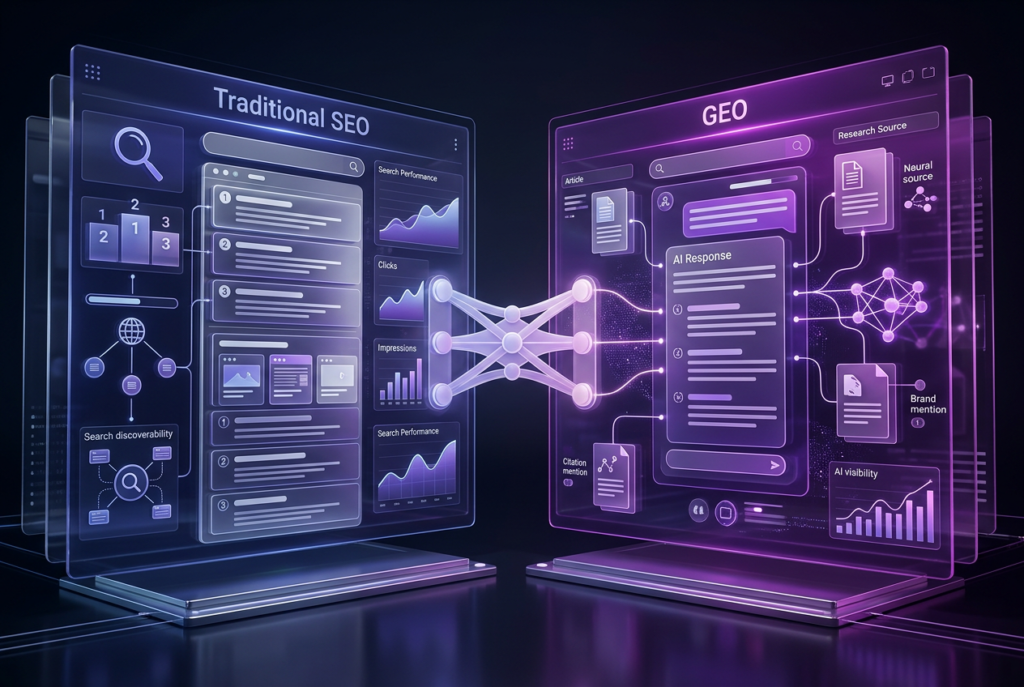
What Is Generative Engine Optimisation (GEO)?
GEO, or generative engine optimisation, is the discipline of optimising digital information so that AI-powered search algorithms can comprehend, retrieve, summarise and perhaps reference it when creating replies. These systems may include AI search engines, conversational assistants and response engines that synthesise knowledge from multiple sources.
Generative systems often respond to user queries directly, whereas traditional search engines mostly deliver ranked connections to websites. Their answers may include citations, source references, summaries, and suggestions. Businesses must disclose information that is accurate, relevant, properly organised, and backed by solid facts.
AI search optimization means understanding the user’s intent and answering specific questions directly, while also showing your expertise and presenting information in a way AI systems can understand. The second major topic is LLM optimization, which seeks to make information more accessible and valuable for large language model-based systems.
Businesses considering GEO vs SEO should know that generative optimisation is built on proven content marketing strategies. Even if the end destination is an AI-generated answer instead of a traditional list of search results, high-quality content, technological accessibility, and legitimacy remain important.
What Is Traditional SEO and Where Does It Still Win?
Traditional SEO improves a website’s presence in search engines’ unpaid results. It involves technical upgrades, content optimisation, keyword research, internal linking, and reputation-building efforts to help search engines locate, understand, and rank relevant sites.
SEO ranking factors depend on relevancy, content quality, site usability, linkages, and several technical variables. The exact impact varies across search engines, and no one checklist will ensure a high ranking. Search engines use complex processes to evaluate which results best answer a query.
Traditional search still has its place, particularly when consumers want to check different sources, browse specific websites, compare product pages, read in-depth advice, or make purchases. For example, if someone is looking for a certain service, they may want to look at company directories and official websites before calling.
AI search optimization is becoming increasingly important, but it does not diminish the relevance of traditional search performance. Search engines remain a major discovery source, and many AI-powered search experiences still depend on accessible online content.
For enterprises, the practical strategy is to maintain a solid technological base and produce usable pages that fulfil user purpose. These efforts improve organic visibility, making it easier for AI-powered systems to understand and reference content.

GEO vs SEO: Key Differences at a Glance
When you look at their aims, how they make you visible, and how they are measured, it becomes clear how GEO vs SEO. They don’t share the same aims, but they do share many underlying ideas.
The main distinctions are:
- Core purpose: GEO is about increasing the odds of being mentioned in AI-generated replies, whereas classic SEO is about raising exposure in traditional search results.
- Keyword strategy: GEO considers conversational queries, natural language, and related topics. Traditional SEO also focuses on keyword research to find relevant search phrases and content possibilities.
- Technical priorities: Both demand material that is accessible and discoverable. Traditional SEO also focuses on crawlability, indexability, website speed, and user experience.
- Performance Measurement: Measure GEO performance by AI citations, brand exposure, referral traffic and conversions. Traditional SEO measures ranks, impressions, clicks, organic sessions, and conversions.
One key variation is the format of visibility. Traditional search engines provide a list of results, and users pick which sites to view. Generative systems may pull information from several sources and generate a response before a user even views a website.
This difference affects content planning. A website built for the short term may not be enough to answer a comprehensive query that a user asks an AI assistant. In contrast, a guide with strong information and clear explanations may still need technological optimisation to compete in traditional results.
Both tactics can matter for brand mentions, but their importance depends on the context and the platform. Relevant links may also aid with traditional SEO, and independent references can help build a brand’s reputation. Businesses should focus on real recognition and meaningful information, not on trying to create mentions.
How Organic Search and AI Search Rank Content Differently
Traditional organic search engines often rank sites using techniques meant to find relevant, helpful, and reliable results. These algorithms consider many signals, such as the content of the site, links, usability, and how a query relates to accessible material.
AI-assisted search involves several steps, including interpreting the question, retrieving sources, extracting the material, synthesising it, and selecting citations. Different platforms have slightly different processes, and not all AI assistants browse the live web to generate every answer.
For example, a user can query, “Which project management tool is good for a small remote team?” A traditional search engine would provide software comparisons, product pages and reviews. An AI search engine may pull together sources into a side-by-side comparison that includes price, collaboration features, and ease of use.
Businesses should aim to answer specific questions directly to make their information more relevant, and provide enough context for each statement to be understood. Definitions, concrete instances, facts, and explicit comparisons let readers assess material without wading through fluff.
A good geo strategy also needs to address how users communicate complex needs. Rather than using broad phrases, marketers might build content that covers comparisons, troubleshooting, product compatibility, and concerns about making the right choice.
But you shouldn’t assume artificial intelligence systems use a single, all-purpose rating formula. Some platforms pull in current web pages, others use their own indexes, and some create responses mostly from knowledge in their built-in models or linked data. The identical site may so surface in one AI answer but not another.

Ranking Signals That Matter for Both SEO and GEO
Traditional search and AI-powered discovery differ in how they deliver information, but both need material that is trustworthy, accessible, and relevant. First, businesses need to strengthen their common foundations before spending heavily on platform-specific strategies.
GEO and SEO are grounded in these common ideas. Instead of treating every new AI platform as a new optimisation project, companies can spend their money on changes that improve content quality and make it easier to find.
Content Formats That Work for Both Search Types
Different types of material serve different search intents. A healthy content library should include in-depth instructional material, quick answers, comparisons, product details, and supporting proof.
- Detailed guides: These are comprehensive write-ups that break down complicated subjects. A professionally planned guide may describe a topic, list pros and cons, explain the procedure, and answer common questions. Clear headers help readers and AI systems find key content and support traditional search visibility.
- FAQs: FAQs are a list of questions and answers that address specific issues that emerge throughout the inquiry. Each response should explicitly address the question and include enough background to avoid misleading simplifications. Questions should be real user questions, not just ways to boost keyword frequency.
- Original research and case studies: Survey results, recorded project results, expert interviews, and open methods may be part of the material’s uniqueness. Statistics should be correctly computed, referenced, and accompanied by their applicable constraints.
- Expert explanations: Including informed analysis and fresh opinions helps show your topic expertise. They should back up their main statements with proof, and separate views from proven facts.
For AI-generated answers to questions, content that presents direct explanations alongside detailed supporting information can be especially useful. For example, a page may begin with a concise definition before exploring examples, practical considerations, and related questions.

How to Build a Combined SEO and GEO Strategy
By combining SEO and geo strategy, companies can boost exposure in conventional search results and make their content more discoverable on AI-powered discovery platforms. Understanding your audience is the starting point, followed by SEO and GEO strategy technological refinements, content creation, and regular assessment.
The best way to optimise AI search sustainably is not to pursue every new platform feature. Instead, create a site that is trustworthy, informative, technically accessible, and adjust how you present its content as search experiences change.
How to Measure Success: Rankings, Citations and Traffic
Measuring performance is more than just verifying that a website is on the top page of a search engine. Businesses need to look at both traditional search results and AI-generated visibility to understand how consumers find their content.
In conventional SEO, the KPIs that matter are keyword ranks, search impressions, organic clicks, click-through rate, landing-page sessions and conversions. Google Search Console lets website owners see search impressions and clicks. Web analytics programs reveal how visitors engage with landing pages.
For GEO, companies can see how often their brand or website appears in answers to relevant enquiries on certain AI systems. You can learn a lot from citation frequency, connected sources, referral sessions, brand mentions, and the accuracy of the generated descriptions.
The following metrics may help assist a structured measurement process:
- AI citations: Track the number of times the site is cited by certain AI engines while responding to queries on relevant subjects.
- Brand mentions: Check whether the firm is mentioned in AI-generated replies, even without a direct link to its website.
- Conversions: Track enquiries, purchases, registrations and other important actions related to search discovery.
Interpret these measurements with caution. AI replies may vary based on how a question is asked, where it is asked, the platform, the model version, and the sources accessible. A single successful citation does not guarantee continuous exposure, and a missing citation does not indicate the material has no effect.
Businesses may establish a repeatable testing process by choosing a limited set of pertinent questions and examining them regularly. Base questions on genuine client needs: compare providers, understand a process, find appropriate solutions.
Referral traffic and conversions are especially crucial, since visibility doesn’t always bring commercial value. An AI-generated response may not lead to a website visit, even if it mentions a firm. Or, a reference may introduce a prospective consumer who returns via another route.

Does GEO Replace SEO? What Businesses Should Do Next
GEO is not a replacement for conventional SEO. The two approaches address different parts of internet discovery, and many of their underlying practices complement each other. Businesses require accessible websites, relevant content, dependable information, and an awareness of their consumers.
Traditional search still lets users find information, compare sources, and go straight to sites. AI-powered search may offer a new experience, synthesising information and displaying selected references in a generated answer. Either experience may impact how future clients discover a firm.
So the future of GEO versus SEO is more likely to be convergence than full replacement. Organisations that concentrate just on rankings may miss out on possibilities to be included in AI-generated answers. Businesses that focus only on AI citations may miss out on significant website traffic from traditional search engines.
Finally, organisations should not see any certain optimisation strategy as a guarantee of AI visibility. Generative systems are different: their behaviour evolves, and their selection methods are not fully apparent. A flexible approach built on quality, trustworthiness and demonstrable achievements is much more durable than pursuing speculative ranking shortcuts.
Summary
Ultimately, generative engine optimisation and conventional search optimisation are complementary routes to digital presence. Combining solid website principles with content that answers real queries may increase a business’s chances of reaching consumers through both traditional results and AI-driven discovery.